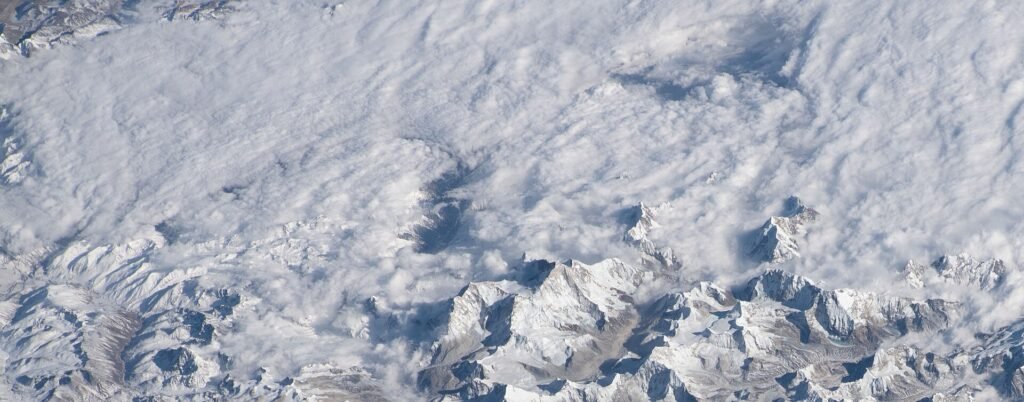
First Ascents of the Karakoram Giants: A Chronology
The Karakoram was surveyed in the nineteenth century and largely unclimbed until the middle of the twentieth. Then, in a compressed period between 1953 and the early 1960s, most of its greatest summits fell in quick succession.
| Year | Peak | Height | Party |
|---|---|---|---|
| 1953 | Nanga Parbat | 8,126 m | Hermann Buhl, solo from the last camp (German–Austrian expedition) |
| 1954 | K2 | 8,611 m | Achille Compagnoni, Lino Lacedelli (Italian, led by Ardito Desio) |
| 1956 | Gasherbrum II | 8,034 m | Fritz Moravec, Josef Larch, Hans Willenpart (Austrian) |
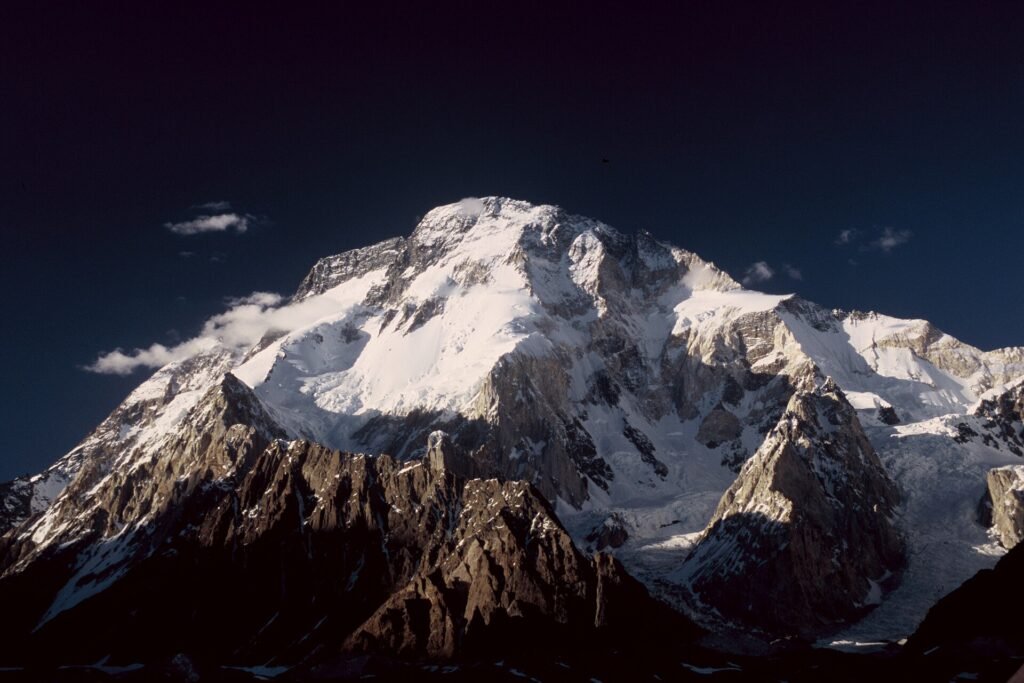
| 1957 | Broad Peak | 8,051 m | Hermann Buhl, Kurt Diemberger, Marcus Schmuck, Fritz Wintersteller (Austrian) |
| 1958 | Gasherbrum I | 8,080 m | Pete Schoening, Andrew Kauffman (American) |
| 1958 | Gasherbrum IV | 7,925 m | Walter Bonatti, Carlo Mauri (Italian) |
| 1958 | Rakaposhi | 7,788 m | Mike Banks, Tom Patey (British–Pakistani) |
| 1960 | Distaghil Sar | 7,885 m | Austrian expedition |
| 1960 | Masherbrum | 7,821 m | George Bell, Willi Unsoeld (American–Pakistani) |
| 1976 | Trango Nameless Tower | 6,239 m | Joe Brown, Mo Anthoine, Martin Boysen, Malcolm Howells (British) |
Why so late, and then so fast
The Karakoram is remote even by Himalayan standards, and access was the binding constraint. Before roads reached the northern valleys, simply arriving at a base camp was a month’s work. Two world wars removed most of a generation of European alpinists and the money that funded them, and partition in 1947 reorganised the political map the expeditions had to cross.
What followed was a burst of national expeditions: Italian on K2, Austrian on the Gasherbrums and Broad Peak, American on Gasherbrum I and Masherbrum, British on Rakaposhi. The pattern of the era was the siege, with fixed camps, long supply chains and large porter teams. Then Buhl and his three companions climbed Broad Peak in 1957 without oxygen or high-altitude porters, and demonstrated another way entirely.
The disputed and the complicated
Not every first ascent is a clean line in a table. Some peaks have multiple summits of similar height, climbed years apart by different parties, which makes “first ascent” a question about which top counts. Chogolisa is the standard example, its summits having been reached separately and by different expeditions.
Others carry disputes about what happened near the top. The 1954 K2 expedition produced an argument over conduct that took fifty years and a formal review to settle, and it remains the best illustration of why contemporaneous records matter more than official accounts.
What was left
The giants went early. What remained, and what has occupied climbers since, is the harder question of style: new routes on faces rather than ridges, alpine-style ascents without siege logistics, and the granite towers of the Trango and Latok groups that offer some of the most difficult big-wall climbing anywhere.
Gasherbrum IV’s west face, climbed in 1985 by Robert Schauer and Wojciech Kurtyka without reaching the true summit, is still widely regarded as among the finest achievements in Himalayan climbing, which says something about how the definition of success moved once the summits themselves were gone. The American Alpine Journal archive is the best public record of what has happened on this ground since.