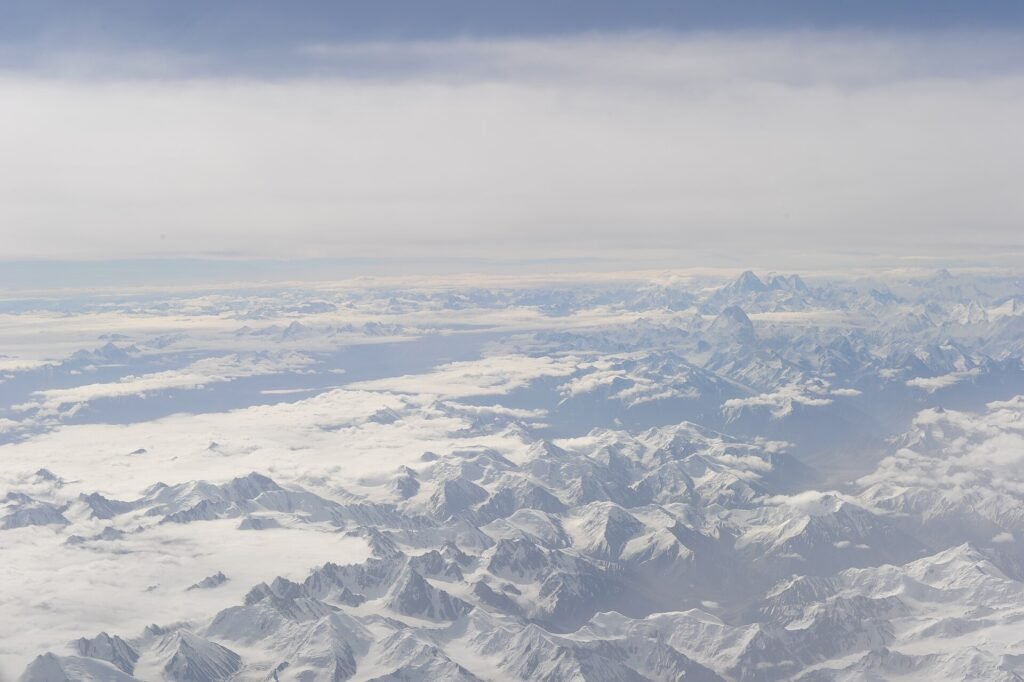
Manaslu base camp buzzes with climbers
Climbers converged on Manaslu (8,163 m / 26,781 ft) in the Nepali Himalaya this September in numbers that Nepal’s Department of Tourism and independent outlets both described as exceptional for the autumn season, even as a group of youths from the nearby village of Samagaun began a hunger strike at base camp demanding action on glacial lake risks. The two developments unfolded in parallel on the same mountain, highlighting both the commercial scale of Himalayan climbing and the concerns of communities living beneath it.
Permits and crowding
According to The Rising Nepal, Suraj Ghimire, Director at the Department of Tourism, said that as of September 13 some 422 climbers — 313 men and 109 women — from 35 expedition teams held permits to climb Manaslu this autumn, and that the mountain had drawn more foreign climbers this season than other peaks The Rising Nepal. ExplorersWeb cited an updated tally from Nepal’s Ministry of Tourism putting the figure at 466 permits for foreign climbers, which it described as an all-time record, and reported that Manaslu was hosting what it called a record number of climbers as the late-summer season reached its peak ExplorersWeb. The two figures diverge, likely reflecting different dates of compilation, and neither outlet reconciled the gap. ExplorersWeb also quoted Pemba Sherpa of 8K Expeditions, a member of the Nepal Tourism Board, telling The Tourism Times that Manaslu Base Camp would host over 1,000 people across the season, a scale he compared to Everest.
Movement toward the mountain
The Rising Nepal reported that climbers and support staff had begun moving from Samagaun toward Manaslu base camp from mid-August, travelling to Samagaun by helicopter, via the Larkey Pass through Manang, or via routes through Gorkha district The Rising Nepal. Bhuban Ojha, Information Officer at the Manaslu Conservation Area Project, said that as of Friday, September 12, 190 climbers via 18 trekking agencies had reached Samagaun. As of September 13, climbers were reported to be acclimatising, trekking, practising technical skills and finishing expedition preparations, while Sherpa guide teams had begun fixing ropes and preparing the route toward the summit. ExplorersWeb’s account from around the same period described climbers rotating to Camps 2 and 3 amid poor weather, with the rope-fixing team awaiting stable conditions to complete the route to the top, and said most expeditions had held puja ceremonies the preceding weekend ExplorersWeb. Weather at base camp was reported as rainy and foggy on the morning of ExplorersWeb’s dispatch.
Incidents, arrivals and the wider season
ExplorersWeb reported that a climber fell into a crevasse below Camp 1 the day before its report, remained clipped to a rope and hanging safely, and was rescued quickly and unharmed; video of the rescue was captured by Phuri Sherpa of EliteExped, an outfit co-founded by the late Nirmal Purja, who died in an avalanche on Broad Peak, and now led by Tejan Gurung alongside co-founder Mingma David Sherpa ExplorersWeb. The same report noted that Italian climber Simone Moro had arrived at Manaslu Base Camp, possibly in preparation for a winter attempt on the mountain in light style, an objective he has pursued several times previously; the year before, a serious cardiac problem while acclimatising on Mera Peak had ended his planned Manaslu expedition before it began, and he has since recovered and climbed Denali. Beyond Manaslu, ExplorersWeb reported that nearly twenty commercial climbers, in two teams from Altipro Adventures and 14 Peaks Expedition, were heading to the considerably less crowded Dhaulagiri (8,167 m), that two Russian climbers were attempting Makalu alone in alpine style, that no commercial expeditions were active on the other 8,000-metre peaks at the time, and that Ama Dablam was expected to begin receiving larger teams in October.
The hunger strike at Manaslu base camp
Online Khabar reported that on September 15, youths from Samagaun in Chumnubri Rural Municipality-1, Gorkha, announced an indefinite hunger strike at Manaslu Base Camp over what they called climate injustice and risk to Himalayan communities, with local youth leader Dawa Norbu Lama saying the protest would run from September 18 to October 4 Online Khabar. The Kathmandu Post, in a report credited to Gorkha correspondent Hariram Upreti, gave a different account: it said eleven youths from Samagaun began an indefinite hunger strike on a Friday near base camp, at an elevation reported as 4,900 metres, led by Dhawa Norbu Lama, who was quoted saying “We started the hunger strike today and will continue until our demands are met” and that there were no personal interests behind the action, and dated the announcement to September 13, following the Bhotekoshi flood in Rasuwa The Kathmandu Post. The two outlets differ on the number of participants, the start date and the spelling of the leader’s name, and neither explained the discrepancy. Online Khabar noted that the youths submitted an eight-point memorandum to the Gorkha Chief District Officer, the Ward Chair, the Manaslu Conservation Area Project’s local office and Samagaun Police Post, while Dawa Norbu Lama said he would begin alone, though others had expressed willingness to join him.
The demands and their context
The memorandum, as detailed by Online Khabar, calls for assessment of growing risk from glacial lakes around Manaslu Base Camp and Samagaun, citing the appearance of several new glacial lakes this year and concern over possible glacial lake outburst floods Online Khabar. It names lakes including Pungen at the foot of Manaslu, Birendra Lake, Kal Tal, the lake at Ghunsarphuk, and three large high-risk lakes at Nyochuthan for aerial monitoring, depth measurement and detailed risk study, alongside installation of water-level sensors and warning sirens, joint Nepal–China study of glacial lakes and glaciers, and regular monitoring by bodies such as the Manaslu Conservation Area Project. The Kathmandu Post likewise reported that the eight-point demands include joint Nepal–China monitoring of glacial lakes in Tibet that could threaten settlements on the Nepali side of the border The Kathmandu Post. Further points call for incorporating climate change into school curricula in Himalayan areas, holding climate-related meetings in mountain communities rather than only in cities, and preparing Himalayan settlements against a forecast stronger El Niño effect in 2027, while the youths noted Nepal’s estimated 0.4 percent share of global pollution and demanded climate compensation and justice from developed nations.
Background: floods and risk across the region
The Kathmandu Post linked the protest’s origin to the Bhotekoshi flood in Rasuwa, which the youths cited as prompting their announcement The Kathmandu Post. ExplorersWeb separately reported that Bhotekosi River flooding roughly three weeks earlier had killed thousands, and that Nepal’s Department of Tourism had confirmed 310 foreign tourists rescued and 13 others located alive after being unaccounted for, most of them Mount Kailash pilgrims caught in remote areas near the Tibetan border ExplorersWeb. At the time of that report, 607 people of 34 nationalities remained missing, including 189 from India, 65 from the United States, 55 from Malaysia, 54 from Ukraine, 37 from China, 33 each from Australia and Latvia, 32 from the United Kingdom and 30 from Canada. Despite this, Nepali authorities and outfitters encouraged visitors to keep their travel plans, saying trails, accommodation and base camps remained open. Manaslu itself carries the nickname “Killer Mountain” and is often the first 8,000-metre peak attempted by many climbers, according to The Rising Nepal, which also noted that the mountain was first summited on May 9, 1956, by Japanese climber Toshio Imanishi and Nepali citizen Urken Tshering Sherpa The Rising Nepal.
What is not yet confirmed
It remains unclear which permit figure — the Department of Tourism’s reported 422 as of September 13 or the Ministry of Tourism’s later tally of 466 cited by ExplorersWeb — represents the final or most current count for the season The Rising Nepal ExplorersWeb. The discrepancy between Online Khabar’s and The Kathmandu Post’s accounts of the hunger strike, including the number of participants, the precise start date, and the correct spelling of the lead organiser’s name, has not been resolved Online Khabar The Kathmandu Post. Whether the memorandum received any formal response from the Gorkha Chief District Officer, the Ward Chair or the Manaslu Conservation Area Project has not been reported. It is also not confirmed whether the hunger strike proceeded as planned through October 4, nor how many youths ultimately joined beyond its initial leader. Finally, no outlet has confirmed whether Simone Moro’s presence at base camp was explicitly tied to a winter Manaslu plan rather than another objective.
Sources referenced
- Manaslu base camp buzzes with climbers — The Rising Nepal
- Samagaun youths announce hunger strike against climate injustice — Online Khabar
- A Crowded Manaslu Waits Out the Rain; Dhaulagiri Begins — ExplorersWeb
- Nepal youths begin hunger strike at 4,900 metres over glacial lake risks — The Kathmandu Post
Written by Andoram by combining 4 independently published reports, each linked above. We synthesise facts and reproduce no source text.
Coverage timeline
- Game Over on Manaslu — Outfitters Send Everyone Home — ExplorersWeb, 22 Sep 2026, 14:24 UTC
- Youth suspend hunger strike at Manaslu Base Camp after govt assures action on demands — Online Khabar, 21 Sep 2026, 04:37 UTC
- Gandaki government urges Manaslu Base Camp hunger strikers to join talks — Online Khabar, 20 Sep 2026, 09:47 UTC
- Nepal youths begin hunger strike at 4,900 metres over glacial lake risks — The Kathmandu Post, 18 Sep 2026, 15:45 UTC
- Puja ceremony held at Manaslu — The Rising Nepal, 18 Sep 2026, 02:14 UTC
- Manaslu climbing season begins with record 466 climbers — Online Khabar, 17 Sep 2026, 03:11 UTC
- A Crowded Manaslu Waits Out the Rain; Dhaulagiri Begins — ExplorersWeb, 15 Sep 2026, 17:43 UTC
- Samagaun youths announce hunger strike against climate injustice — Online Khabar, 15 Sep 2026, 13:21 UTC
- Manaslu base camp buzzes with climbers — The Rising Nepal, 13 Sep 2026, 04:18 UTC
This page is an automatically compiled index of third-party reporting. Headlines and links belong to their publishers; Andoram reproduces no article text. Last compiled 23 Sep 2026 14:15 UTC.