The Men Who Carried the Baltoro
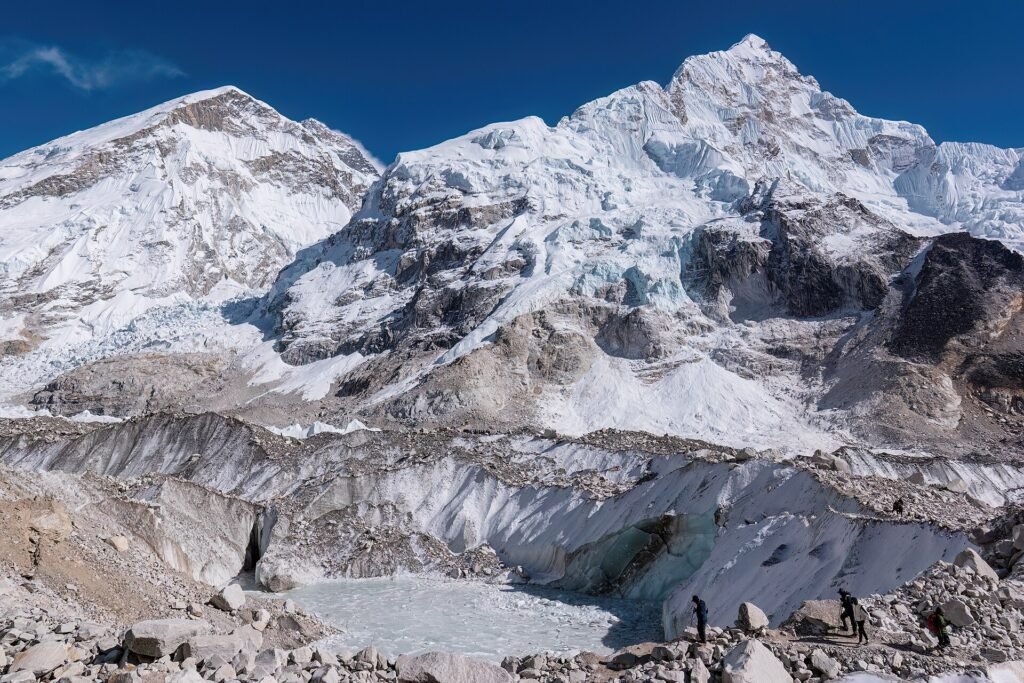
There is a photograph taken at almost every Karakoram base camp, in almost every decade, and it shows the same thing: a line of men on a glacier, each under a load, moving towards a mountain that will be named after somebody else’s achievement.
The history of climbing in the Karakoram is usually written as a sequence of first ascents. It could as accurately be written as a labour history, and that version has better numbers in it.
The arithmetic of the approach
The Baltoro Glacier is roughly sixty kilometres of moraine, ice and rubble between the roadhead at Askole and the amphitheatre at Concordia. Nothing grows on it. Nothing can be bought on it. Every kilogram consumed by an expedition, and every kilogram consumed by the people carrying for that expedition, walks in on somebody’s back.
A porter load is conventionally about 25 kg. Because porters must also be fed, and their food must also be carried, the number of people required grows faster than the length of the trip. A large expedition to K2 Base Camp has historically required hundreds of porter-stages to place a handful of climbers at the foot of the route.
This is why the great expeditions of the 1950s look, in their logistics, less like sport and more like small military operations. The climbing was done by a few. The mountain was reached by many.
Askole, the last village
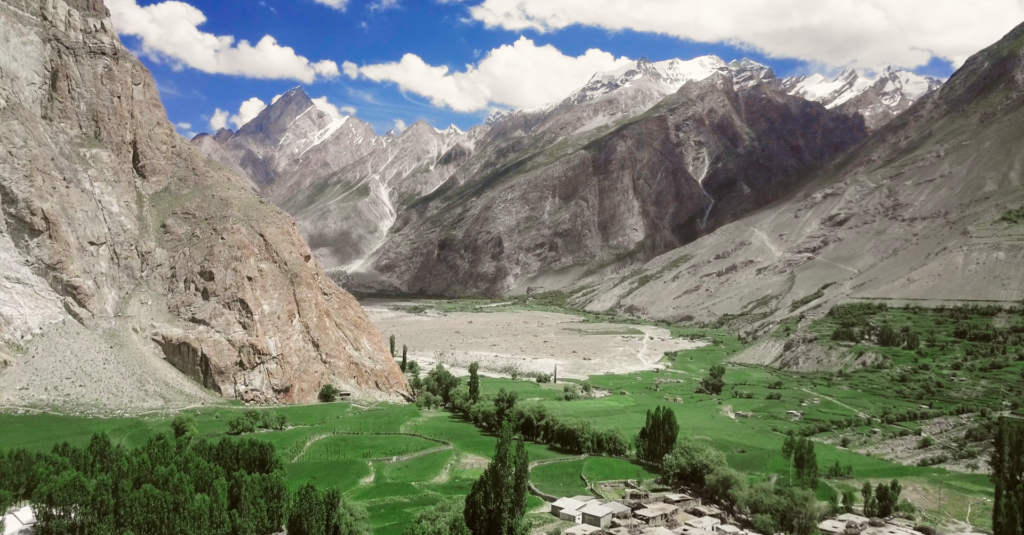
Almost everything begins at Askole. It is the final settlement on the road, a cluster of stone and mud houses with apricot trees and irrigation channels, sitting at around 3,000 m where the cultivated world stops and the glacier system starts.
For most of the twentieth century Askole supplied the labour for every expedition heading up the Baltoro, and the seasonal economics of the village were shaped accordingly. Portering is hard, badly paid relative to its risk, and concentrated into a short summer, but in a place with limited alternatives it has been one of the few reliable ways to earn cash. That dependency cuts both ways, and it is the reason porter negotiations have historically had an edge to them.
Who they were
Most were Balti, from the villages of Baltistan and in particular from Askole, Hushe and the Shigar valley. Others came from Hunza, further north, and both groups appear throughout the expedition records of the twentieth century.
They were not merely load carriers. Many were mountaineers by any reasonable definition, operating on the same ground as the foreign climbers, frequently higher, usually with worse equipment and always for less recognition. Amir Mehdi, the Hunza porter who carried oxygen towards K2’s summit in 1954 and spent a night in the open above 8,000 m for his trouble, lost his toes and his climbing career on that carry. He appears in the contemporary accounts largely as a logistical difficulty.
Later generations became better known. Pakistani high-altitude climbers eventually made ascents under their own names rather than in support of somebody else’s, among them Ali Sadpara, from a village near Skardu, who was part of the first winter ascent of Nanga Parbat in 2016 and who disappeared on K2 in the winter of 2021.
Why the Baltis are less famous than the Sherpas
The comparison is unavoidable, and the answer is mostly commercial rather than mountaineering. Nepal opened to mass trekking earlier and more completely, and the Sherpa name travelled with an industry that grew around Everest, acquiring a global brand in the process.
Pakistan’s mountains never generated that volume. The Baltoro receives a fraction of Everest’s traffic, the season is short, access is harder, and the political situation has periodically closed the range altogether. Fewer visitors means fewer books, fewer films and fewer names in circulation.
The result is that a body of high-altitude expertise as deep as any in the world is comparatively invisible outside Pakistan.
The disputes nobody records
Expedition accounts occasionally mention porter strikes, usually with irritation, and usually at Paiju, the last real camp before the glacier proper. Read from the other side, these were labour negotiations conducted at the only moment when the workforce had leverage: after the loads were committed and before the hard ground began.
Wages and stage rates in Gilgit-Baltistan are now regulated, with published rates and rules covering load limits and equipment. Enforcement is another matter, and it is one of the few parts of an expedition budget where cutting costs transfers real physical risk onto other people. An operator paying below rate, or sending men onto a glacier in inadequate boots, is not being efficient.
What this means for how you travel
None of this is only history. The structure that carried Desio’s expedition in 1954 is the structure that carries trekking groups today, and the decisions a visitor makes have direct consequences for the people under the loads.
The practical version is unglamorous: pack less, because weight is somebody’s back. Ask your operator what porters are paid, whether they are insured, and what equipment they are issued. Question a quote that undercuts the market, since the saving is coming from somewhere. Our guide to what a Karakoram expedition actually costs sets out where the money goes and which economies are false ones.
Reading the record properly
The archives are better than they used to be. Expedition reports in collections such as the American Alpine Journal increasingly name local staff rather than aggregating them into a number, and the correction of the 1954 record did as much for Amir Mehdi’s standing as for Walter Bonatti’s.
But the underlying structure has not changed. Someone still carries the food to Concordia. The mountains above it, Masherbrum, the Trango Towers, K2 itself, are reached the same way they were in 1954, on foot, under load, by men from the villages downstream.
The next time you read that an expedition reached base camp, it is worth asking how.