Acclimatisation in the Karakoram: Reading Altitude Before It Reads You
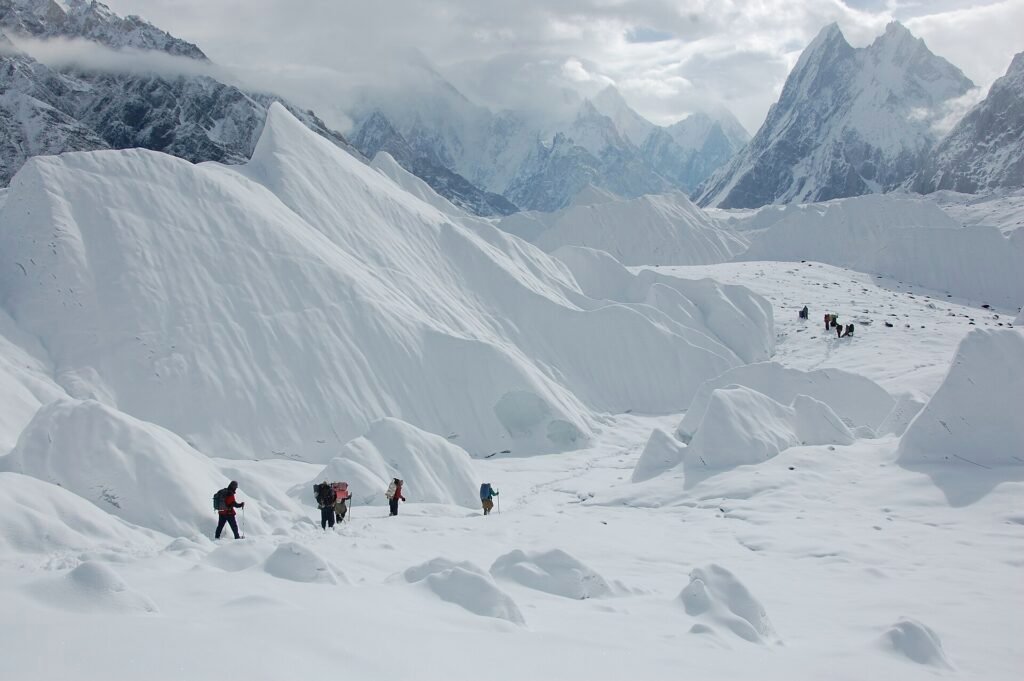
Most altitude advice is written for Nepal, where you fly into Lukla at 2,860 m and start climbing more or less immediately. The Karakoram works differently, and the difference is what catches people out. The approach to K2 is long, the gradient is gentle, and the trail spends days barely gaining height. It feels generous. Then Concordia arrives and you are at 4,600 m, having done nothing that felt like effort.
The ladder you are actually climbing
Read the Baltoro as a sequence of sleeping altitudes rather than a distance. Skardu sits near 2,230 m. Askole, the last village and the roadhead, is around 3,000 m. Paiju is roughly 3,400 m, Urdukas around 4,050 m, Concordia about 4,600 m, and K2 Base Camp near 5,150 m. Parties exiting over the Gondogoro La cross at roughly 5,585 m.
Written as a list, that looks like a sensible progression. Walked, it hides a trap: the largest single jumps come late, when you are already tired, already at altitude, and already committed to a schedule with porters and permits attached to it.
What acclimatisation actually is
Altitude does not reduce the percentage of oxygen in the air, which stays near 21% all the way up. It reduces the pressure driving that oxygen across the lung membrane into your blood. At 5,000 m the barometric pressure is roughly half that at sea level, so each breath delivers about half the oxygen.
The body responds on several timescales. Within hours you breathe faster and deeper. Within days your kidneys shed bicarbonate so that faster breathing can continue without tipping your blood chemistry too far. Over one to three weeks you build red blood cells. The first two adaptations are the ones a trek relies on, and neither can be hurried. Altitude is therefore a scheduling problem before it is a fitness problem, which is why strong, young, impatient people get sick most often: fitness lets you outrun your own adaptation.
Three things to recognise
Acute mountain sickness is the common one. A headache that arrives after ascent, plus any of nausea, unusual fatigue, dizziness or broken sleep. It is graded with the Lake Louise score, but on the ground the useful version is simpler: a headache above 3,000 m that is not obviously dehydration should be treated as altitude until it proves otherwise.
High-altitude pulmonary oedema is fluid in the lungs. The signal that matters is breathlessness at rest, especially with a dry cough that turns wet, and a sudden collapse in capacity. Someone who kept up yesterday and cannot walk uphill today is a red flag regardless of what they say about being tired. HAPE can develop over hours.
High-altitude cerebral oedema is swelling of the brain, and it kills fastest. The field test is balance. Ask the person to walk a straight line heel to toe. If they cannot, treat it as HACE and descend immediately, at night if necessary. Confusion, unusual behaviour or drowsiness carry the same weight. Do not wait for morning, and do not let the person argue: the organ making the argument is the affected one.
The rules that survive contact with a real trek
Above 3,000 m, gain no more than about 500 m of sleeping altitude per day. Climbing higher during the day and returning to sleep lower is not merely permitted, it is the mechanism. Take a rest day roughly every 1,000 m of gain, and understand that a rest day means sleeping at the same height, not walking a shorter distance.
Never ascend to sleep higher with symptoms of AMS. This single rule prevents most serious cases. If symptoms improve, continue. If they worsen, descend. Descent is not one treatment among several; it is the treatment. Five hundred metres often produces dramatic improvement, and there is no altitude illness that descent makes worse.
Medication exists and has a real place, but it is prescription territory and dosing depends on the individual. Discuss it with a travel or mountain medicine practitioner before departure, not with a fellow trekker at Urdukas. The UIAA Medical Commission publishes free consensus advice worth reading in advance.
Sleep, water and the things that masquerade as altitude
Broken sleep at altitude is normal and is not by itself illness. Many people experience periodic breathing, in which respiration cycles between deep breaths and pauses, sometimes waking them with a sensation of suffocation. It is unpleasant, common above about 4,000 m, and not dangerous in isolation.
Dehydration is the great imitator. Cold, dry air and heavy breathing strip water faster than thirst reports it, and the resulting headache and lethargy look exactly like mild AMS. Drink deliberately rather than by thirst. The distinction matters, because the response to dehydration is water and rest, while the response to worsening AMS is losing height.
Pulse oximeters have become common on treks and are worth carrying, but read them carefully. Saturation falls with altitude in everyone, individual variation is wide, cold fingers produce nonsense, and a reassuring number has talked people out of descending when their symptoms should have talked them into it. The device informs a decision; it does not make one.
Why the Karakoram raises the stakes
In Nepal, descent usually means walking downhill towards a village, a road and eventually a clinic. On the Baltoro, descent from Concordia means several days back down a glacier to Askole, then a long jeep ride to Skardu. There is no teahouse at the bottom of the hill.
Helicopter evacuation exists but is not a plan by itself. It requires flyable weather in a valley system that manufactures its own cloud, a working communication link, and in practice a financial guarantee before the aircraft lifts. Insurance that explicitly covers helicopter rescue and repatriation at Karakoram altitudes is not optional, and you should check what altitude ceiling your policy actually names. The expedition reports collected in the American Alpine Journal are a sobering education in how long a rescue can take once weather closes a valley.
The Gondogoro La deserves separate thought. Crossing it puts you above 5,500 m on a technical pass, typically starting around midnight, after two weeks that have already worn you down. Parties who have acclimatised properly find it hard. Parties who have not find it dangerous, and the far side is not where you want to discover you are ataxic.
The honest summary
Build buffer days into the itinerary before you book, because you cannot add them once porters are hired and permits are dated. Treat any headache as information. Watch your companions more carefully than yourself, since altitude degrades exactly the judgement you would need to assess your own condition. And accept the trip you get rather than the one you planned, because the mountain does not negotiate and the descent always works.
This article is general information for trip planning, not medical advice. Altitude illness can be fatal within hours. Consult a qualified practitioner before travelling and follow the guidance of your expedition medical staff in the field.