Afternoon Water: Why Glacial Stream Crossings Are a Morning Job
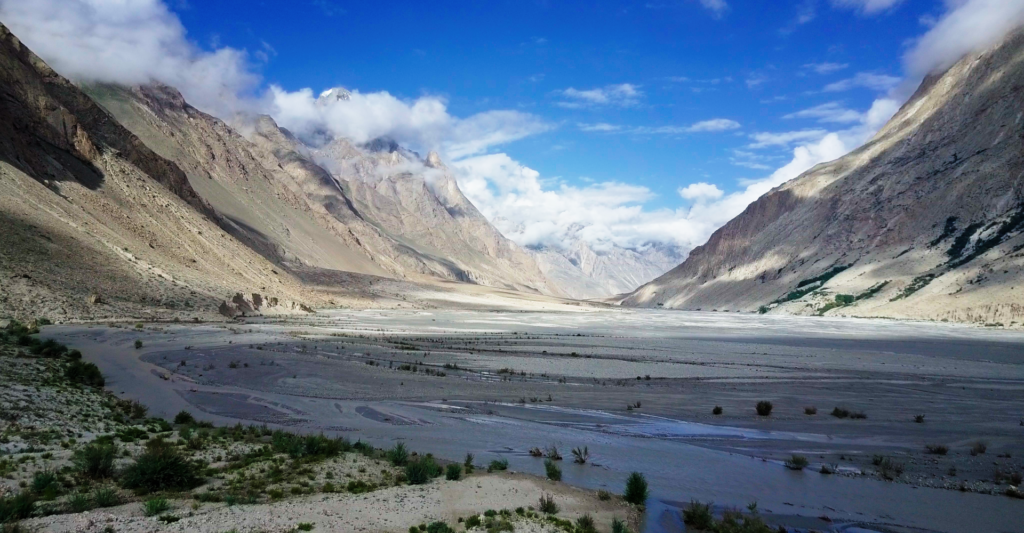
One of the few genuinely predictable things about the Karakoram is that its rivers keep a timetable. Understanding it prevents a specific and entirely avoidable category of trouble.
The daily cycle
Glacial meltwater is driven by heat. Overnight, temperatures on the ice fall well below freezing and melting largely stops, so streams run at their lowest in the early morning. As the sun works through the day, melt accelerates, and the water arrives at the channels with a lag of some hours.
The practical result is that most glacier-fed streams are at their lowest between roughly dawn and mid-morning, and at their highest in the late afternoon and early evening. The difference is not marginal. A channel that is an easy step in the morning can be waist-deep, opaque with silt, and rolling stones along its bed by late afternoon.
Hot, clear days produce the biggest swings, which is the mild irony of good weather in the mountains: the conditions that make walking pleasant also make the water dangerous.
Why this shapes the day
It is the main reason Karakoram trekking days start early and finish early. An 05:00 start is not machismo. It puts the party across the water while the water is small, and it gets people into camp before the afternoon becomes unpleasant in several other ways as well.
Rockfall follows a related cycle. Ice that has held stones in place overnight releases them as the sun reaches the walls, so the couloirs and slopes above a trail are more active in the afternoon. The same early start reduces exposure to both hazards.
Reading a crossing
Silty grey water is hiding its bed, so depth cannot be judged by eye. Listen instead: the sound of stones knocking along the bottom tells you the flow is strong enough to move rock, which means it is strong enough to move you.
Look for a braided section, where the stream has split into several shallower channels, rather than crossing a single deep one. Look upstream and downstream for what happens if someone slips, because the consequence matters more than the difficulty. A short, easy crossing above a long chute is worse than an awkward one above a flat gravel bank.
If you must cross
Keep boots on, or carry dedicated crossing shoes. Bare feet on unseen rock in glacial water is how ankles are broken.
Undo the waist belt and chest strap on your pack so it can be shed. Face upstream, move sideways, use poles or a linked group for stability, and take deliberate steps rather than quick ones. Water at these temperatures degrades coordination fast, so a long crossing is worse than a cold one.
And keep dry clothing genuinely dry, in a sealed bag, deep in the pack. Hypothermia does not require a dramatic immersion at 4,000 m; wet legs and wind will do it.
When the answer is no
Sometimes the correct decision is to wait until morning. This is unpopular when camp is an hour away on the far side, and it is almost always right.
Water levels also respond to weather further up the valley that you cannot see. Rain on the ice, or a warm night, can leave a stream high when you expected it low. Treat the daily cycle as a strong tendency rather than a guarantee, and let the guide who has crossed it fifty times make the call.
The general rule is simple enough to carry: cross early, camp on the side of the water you need to be on tomorrow, and never let a schedule argue with a river. Season-by-season conditions reporting from outlets such as ExplorersWeb is useful for knowing whether a given summer is running warm.